Still in the fight
Co skipper Will Harris explains why Team Malizia believes they have every reason to focus on overall victory and admits to keeping some secretsMatthew Sheahan
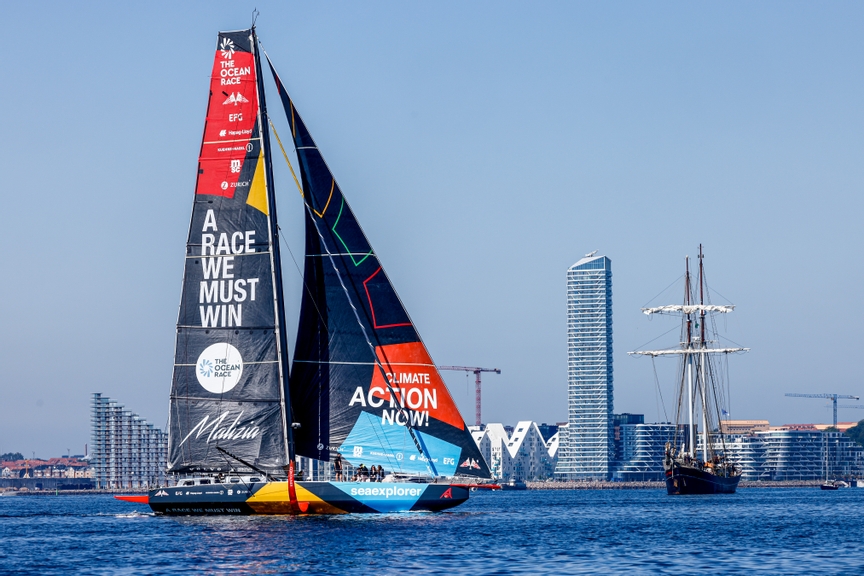
Team Malizia’s performance has been a talking point from the start. Clearly the most unusual looking boat, the consensus was that Boris Herrmann’s black IMOCA would be good solid boat in heavy airs, ideally suited to the Southern Ocean. Indeed, with double points for this leg, this had been part of Herrmann’s focus.
And when it came to the marathon Leg 3 Team Malizia did indeed deliver, despite a near race-wrecking problem with their mast shortly after the start.
But since then it has become clear that the team has learned how to squeeze more performance and put real pressure on the two front runners.
Crew member Will Harris explains how.
“I think the last two legs it’s clear that we've been in the fight for more points,” he said. “Finishing four minutes behind Holcim-PRB in second place in Leg 5 and 26 minutes behind 11th Hour Racing Team in Leg 4, we've been in the fight but we haven't got the score to show for it. Four points is still achievable, especially having five boats back in it so nothing's out of the question, anything can happen. And just because it's a shorter leg doesn't mean that it changes much.
“There's absolutely everything in this leg, exclusion zones are going to always keep it really complicated in the North Sea, the Baltic is going to be light winds and it will be anyone's game and that can really mix things up, so it gives us a chance to catch the guys in front.
“But Biotherm are still seven points behind, anything can happen with them as well. It's exciting to see the race still like this at this point after so many miles. Hopefully 11th Hour Racing and Holcim-PRB will battle it out and forget about us a bit.
“If I think back to Alicante, we'd done six months sailing on the boat and we hadn't really found the mode yet for the boat in these marginal lighter wind conditions. We had just replaced a set of foils as well, which we hadn't initially planned for the boat. I think to where we are now and how much we've learnt about the boat and how much experience we have gained, it has just been phenomenal really.
“The boat really isn't as weak in some conditions as some people thought it would be. In these lighter conditions we are definitely still in the match and having the extra space just makes our lives that much better and keeps us much more positive than the others.
"We've also got this fantastic advantage downwind in strong winds, but we're not completely out of the game by any means in the light stuff and we really saw that in Leg 4. There we didn't have more than 20 knots until the last few miles and we were fully in the fight there and even a lot faster than the other boats so that was really cool. Leg 5, we really wanted more as we felt like we had the skills and the experience in the boat to do it.
“But we had a pretty crucial breakage and blew the tack out of our J2. We kept that back, it was the first time we've played a bit more secret strategy because we really felt that we didn't want the other boats to think we're to any disadvantage. In the end we didn't need the J2 that much but that first bit meant that we were always hunting with the others rather than being in the fight with them. It was only at the very end that we started to get that close to them and I think we were at no disadvantage with this boat.
"It's fantastic to have the space and the ability to really push the boat as a crew. I think that's where we have a good advantage and that's going to be really necessary for this close-quarters racing where you're going to have to be keeping your eyes out at all times. I feel like we can do that a lot better than the other boats.
“Overall, what's struck me is the general understanding of how to set the boat up that has been at the heart of our improvement. There's not one thing I can put my finger on - it's a whole mixture of experience and learning and getting used to the boat. But the more you get used to it, the more you sail, the more you know how to find the new modes. The new foils were a big learning curve for us in the first couple of legs.”
Do you feel that fitting new foils was a lucky escape?
“Our race was almost over at the start. We were very lucky to have an opportunity to replace the foils. These are Sam Manuard designed foils. And we're very impressed with them. They have provided fantastic gains in the boat in the weaker conditions, so in some ways, it's been a bit of a blessing that that's happened. I didn't feel like that in Alicante, I was very, very nervous about that whole situation.
“We can be really happy with how we are now, and how the whole race has gone and I think that's a good situation for us to be in because I feel like we have less pressure going into this. We're the ones who are slightly the underdogs. We want to beat them, we're a bit of a younger team with fewer laps around the planet than the others, so it's cool to be fighting with them really.”
With such an intense tactical race in store, how important will Figaro experience be?
“The Figaro is a great learning ground and experience to go offshore racing, but it's not the key thing for these IMOCAs - you realise that now. They are a one-design class, they're much bigger, there's a different way to sail them and they are a crewed boat rather than a solo boat, so although Figaro sailors tend to have the experience, I don't think is going to make the difference. A few years ago I probably would have given a different answer. But, I came through the Figaro class myself, that's where I got my experience and I know that it's not the only way to do it. I think there's a lot to be said for the amount of time you spend on your boat and the amount of time you've spent with the team and how well each of us know on boats to get the most out of then.
“And then, it's going to come down to who makes the right tactical decision. But Figaro or not, I don't think it gives you so much of an advantage."